

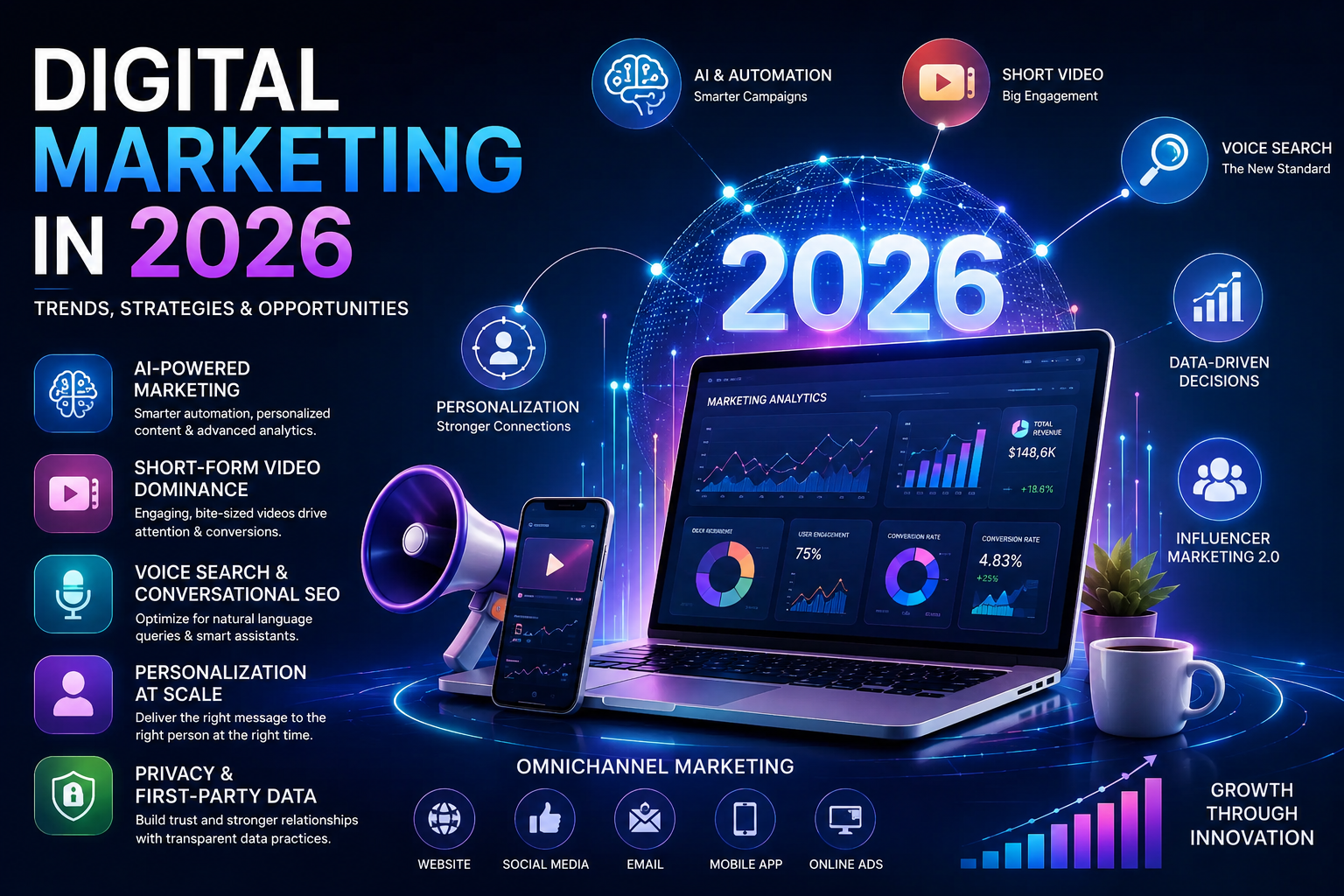
Digital marketing continues to evolve rapidly, and in 2026, businesses must adapt to changing technology, customer expectations, and search engine algorithms. Artificial intelligence, personalized experiences, voice search, and short-form videos are transforming how brands connect with their audiences. Whether you’re a beginner or an experienced marketer, understanding these trends will help you stay ahead of the competition.
AI-Powered Marketing Becomes the Standard
Artificial Intelligence (AI) is no longer just a trend—it is now a core part of digital marketing. Businesses use AI to:
- Generate marketing content
- Analyze customer behavior
- Automate email campaigns
- Create personalized product recommendations
- Improve customer service through AI chatbots
However, successful businesses combine AI efficiency with human creativity to produce authentic and engaging content.
Short-Form Video Dominates
Short videos remain one of the most effective ways to reach customers. Platforms like TikTok, Instagram Reels, and YouTube Shorts continue to drive engagement because users prefer quick, informative, and entertaining content.
Tips for success:
- Keep videos between 15–60 seconds.
- Add captions for silent viewing.
- Focus on storytelling.
- Include a clear call-to-action.
Voice Search and Conversational SEO
As smart speakers and voice assistants become more common, people search differently.
Instead of typing:
“best laptop”
People now ask:
“What is the best laptop for students under $800 in 2026?”
To optimize for voice search:
- Write in natural language.
- Answer common customer questions.
- Use long-tail keywords.
- Optimize for local searches.
Personalization Is Essential
Customers expect personalized experiences across websites, emails, and advertisements.
Examples include:
- Personalized product recommendations
- Custom email offers
- Dynamic website content
- Location-based promotions
Businesses that personalize customer experiences often see higher engagement and better conversion rates.
SEO Focuses on User Experience
Search engines now reward websites that provide valuable content and excellent user experiences.
Important SEO factors include:
- Fast website loading speed
- Mobile-friendly design
- Helpful, original content
- Secure HTTPS websites
- Clear website structure
- High-quality backlinks
Creating useful content for people—not just search engines—is more important than ever.
Influencer Marketing Evolves
Instead of spending large budgets on celebrities, many brands now work with micro-influencers who have smaller but highly engaged audiences.
Benefits include:
- Higher trust
- Better engagement
- Lower marketing costs
- Stronger community relationships
Authenticity has become the key to successful influencer campaigns.
Privacy and First-Party Data
As third-party cookies continue to disappear, businesses rely more on first-party data collected directly from customers.
Common methods include:
- Email newsletter signups
- Loyalty programs
- Customer surveys
- Website accounts
Transparency about data collection helps build customer trust.
Omnichannel Marketing
Customers interact with brands across multiple platforms before making a purchase.
Successful businesses maintain consistent messaging across:
- Websites
- Social media
- Email marketing
- Mobile apps
- Online advertising
A seamless customer journey increases brand loyalty and sales.
Email Marketing Remains Powerful
Despite new platforms, email marketing continues to deliver one of the highest returns on investment.
Best practices:
- Personalize subject lines.
- Segment audiences.
- Automate follow-up emails.
- Provide valuable content.
- Optimize for mobile devices.
Data Analytics Drives Better Decisions
Marketing decisions should be based on data rather than assumptions.
Track important metrics such as:
- Website traffic
- Conversion rate
- Click-through rate (CTR)
- Customer acquisition cost (CAC)
- Return on investment (ROI)
- Customer lifetime value (CLV)
Regular analysis allows businesses to improve campaign performance and maximize marketing budgets.
Tips for Businesses in 2026
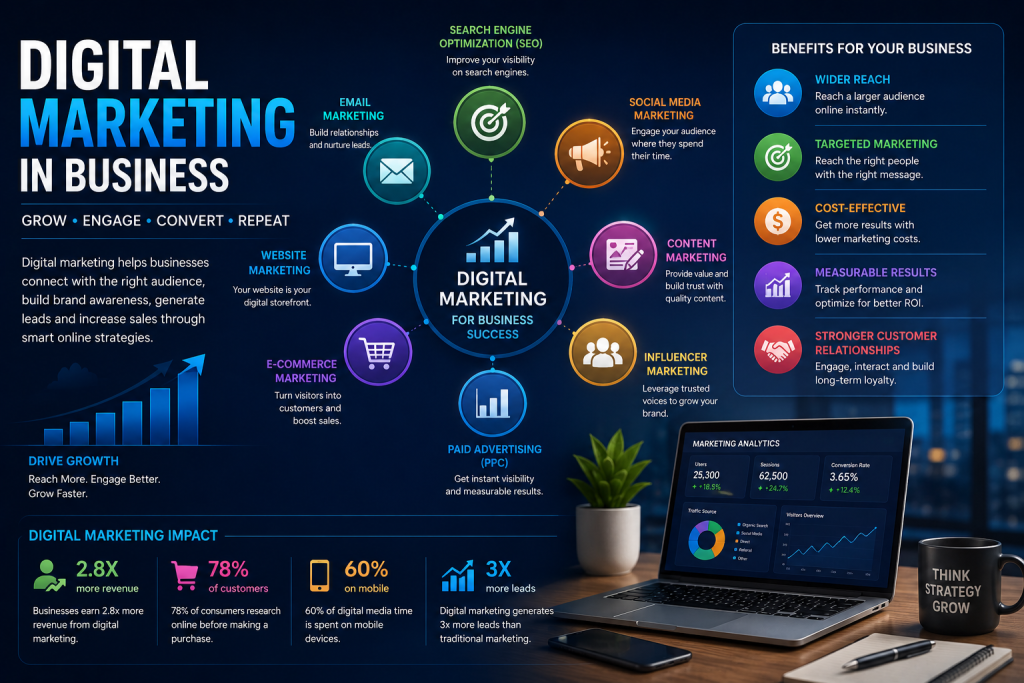
Invest in AI tools while maintaining human oversight. Create high-quality video content. Focus on customer experience. Build trust through transparency. Improve SEO with helpful, original content. Collect first-party customer data ethically. Use analytics to measure and optimize campaigns.
Conclusion
Digital marketing in 2026 is driven by AI, personalization, video content, data privacy, and customer experience. Businesses that embrace innovation while prioritizing authenticity and value will be better positioned for long-term success. Rather than chasing every new trend, marketers should focus on understanding their audience, creating meaningful content, and continuously adapting to the evolving digital landscape.
Suggested SEO Keywords: Digital Marketing 2026, AI Marketing, SEO Trends 2026, Social Media Marketing, Content Marketing, Email Marketing, Voice Search SEO, Digital Marketing Strategy, Online Marketing, Marketing Automation.